Entradas

Mostrando las entradas etiquetadas como Pitfall

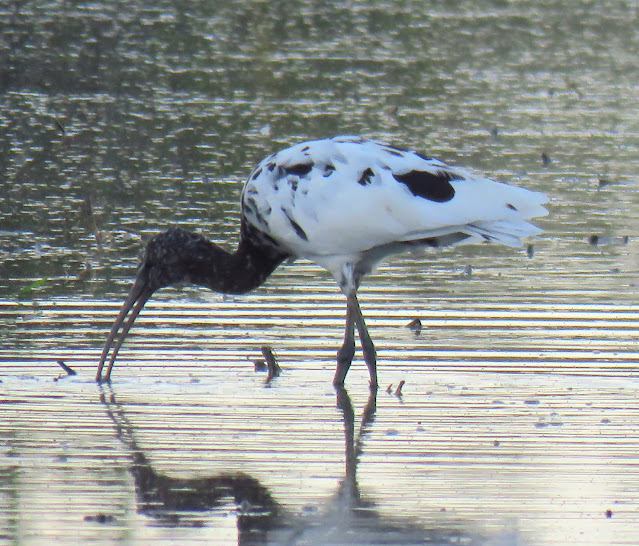
Leucistic Glossy Ibis, an identification pitfall for Sacred Ibis
Imagen
At c.14:20 hour on 3 October 2022, an alleged Sacred Ibis Threskiornis aethiopicus was seen at La Ràpita, Ebre Delta, Montsià, Catalonia. The species is a rarity in the country, besides having been recently considered as a pest species . After some search, on 4 October 2022,   Sergi Sales found the ibis which showed a large white body and black neck. However, a careful observation revealed that indeed it was not a Sacred but a leucistic Glossy Ibis ( Plegadis falcinellus ), a frequent species at Ebre delta numbering c.40.000 birds in autumn 2022 (David Bigas pers.comm.), see @sales_sergi tweet below and his original photo.   Aquests dies pel Delta de l'Ebre volta un Capó reial mig leucístic que esta donant mal de cap perquè la distribució del clar/fosc coincideix bastant amb el seu parent, l'Ibis sagrat. Podem comparar a les fotografies totes dues espècies.Realment un ocell ben curiós @FundPlegadis pic.twitter.com/sWvKwf6Enp — sergi sales🎗 (@sales_sergi) October 12,...

1st summer Northern Gannet pitfall for Brown Booby

Imagen
On 6.7.2019 a brown and white gannet was seen off Arnao, Asturias (Saúl Rodríguez).  See two photos below. The bird was initially identified as a Brown Booby ( Sula leucogaster ) mostly on the basis of the face pattern and overall black and brown plumage. © Saúl Rodríguez, 6.7.2019   © Saúl Rodríguez, 6.7.2019 On 9.7 Daniel López Velasco, after being contacted by Jorge Valella who initially realised the bird was not a Brown Booby, confirmed that the photos of the bird and initial thoughts of Jorge were right so the bird was indeed a 1st summer Northern Gannet ( Morus bassanus ). Features pointing towards Morus were: • Brown chest limit too far from the front edge of the wing compared with Sula leucogaster (see figure below) • White rump (hardly visible in the photos) • Dark underwings Sula leucogaster   © Daniel López Velasco Arnao photos were not taken close enough and face pattern strongly recalled that of Sula leucogaster but a better analysis of the...

Leucistic Sturnus as a pitfall for Rosy Starling

Imagen
Rosy Starling ( Pastor roseus ) is a rarity in Spain despite there are annual records of the species (28 records/birds in mainland and Balearics up to 2010 plus another in the Canary Islands, Source: @CR_SEO). Besides well marked adults, some moulting individuals from juvenile/1w plumages to adult also occur with rather frequency. However, some distant pale and black starlings are not always true Rosy Starlings but can be leucistic starlings. In recent times there have been at least three cases of Spotless Starlings ( Sturnus unicolor ) showing extensive white areas in underparts and mantle: 1. Sturnus unicolor , Valencia, 9 February 2013 (Javier Sánchez at SVO forum ) © Javier Sánchez 2. Sturnus sp. (c.f. unicolor) , Aldea del Rey, c.10 February 2013 ( Gustavo Barba Alcaide blog ) © Gustavo Barba 3. Sturnus unicolor , Odiel marshes, Huelva, 17 February 2013 (Marie Montalva and  José Luís Anguita,  reported to this blog) © Marie Montalva, José Luís A...

Leucistic Stonechat as pitfall of Desert Wheatear

Imagen
On 5.12.2012 a believed-to-be Desert Wheatear Oenanthe deserti was found at Gola de Puçol, near Marjal dels Moros, Valencia. The bird had an obvious all black tail and showed a proper combination of whitish underparts and mantle combined with brown cap, blackish face and bib plus slender black bill. Some pictures were taken and a report was sent to Spanish Rarities Committe (CR-SEO/BirdLife). When seen the (distant) images, it was quickly felt that something was wrong with the expected Wheatear shape, particularly in terms of proportions. After acknowledging the authors and telling them that we were thinking in an aberrant (probably leucistic) Stonechat ( Saxicola rubicola ) rather than a Desert Wheatear, an alert was sent to local birdwatchers. On 6.12.2012 Miguel Tirado and others went to the site of the observation only to confirm the initial suspicions: the bird was indeed an amazing lecistic Stonechat, which almost matched the colour pattern of Desert Wheatear!. Unlike 5.12, ...

Un ganso raro [An odd goose]

Imagen
Se hizo una encuesta en este blog sobre la foto que veis arriba. A preguntas sobre qué era esto, respondieron 33 personas, de las cuales 5 pensaron que era un híbrido (15%), una un mutante (3%), 12 un fotomontaje (36%), dos un ganso no identificado (6%), una una especie nueva para la ciencia (!) (3%) y, empatados con el fotomontaje, 12 (36%) nada de lo anterior. Los últimos estaban en lo cierto dado que se trata de una foto hecha por Miguel Avelino en la charca de Maspalomas, Gran Canaria, Islas Canarias, donde se ve en primer término un Ánsar Careto Grande Anser albifrons (ver la cita en noticias septiembre 2007 ) con la cabeza recogida sobre el costado derecho del ave, izquierdo en la foto y, detrás, un pato criollo Cairina moschata que saca su cabeza justamente donde debería de estar la del ánsar. Del Cairina moschata se ve el cuerpo que sale por el costado derecho de la foto. No es un fotomontaje, sino una ilusión óptica, como tantas que pueden producir las fotografias. Gracia...